Dynamic Stirred Tubular Reactor (DTR)Principles & Structure: An In-Depth Analysis
Saltar a la sección
🔍1. Which types of dynamic tubular reactors exist, and which is the focus?
This article centers on the dynamic stirred tubular reactor (DTR); the other two types will be covered separately.
Three types of dynamic tubular reactors
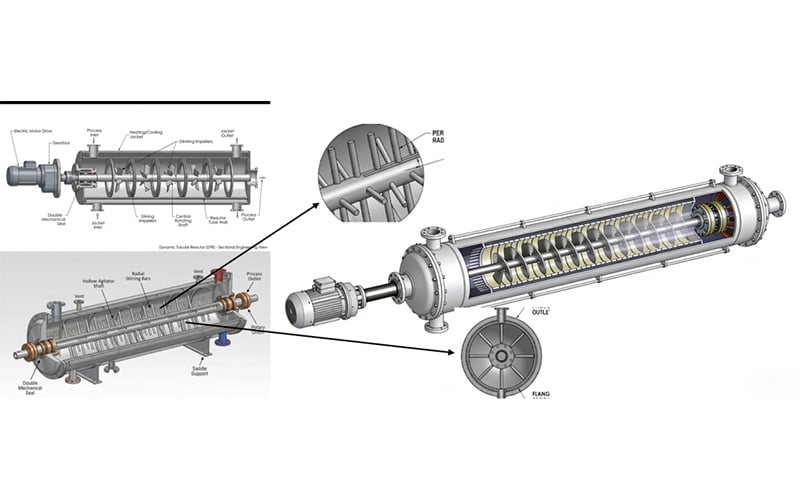
Dynamic Stirred Tubular Reactor (DTR)
Domestically known as the “dynamic tubular reactor,” suited to high-viscosity, solids-containing, coking-prone, long-residence-time processes (e.g., small-molecule solid–liquid reactions, free-radical polymerization, polycondensation). Horizontal paddles / ribbons provide conveying and wall self-cleaning.
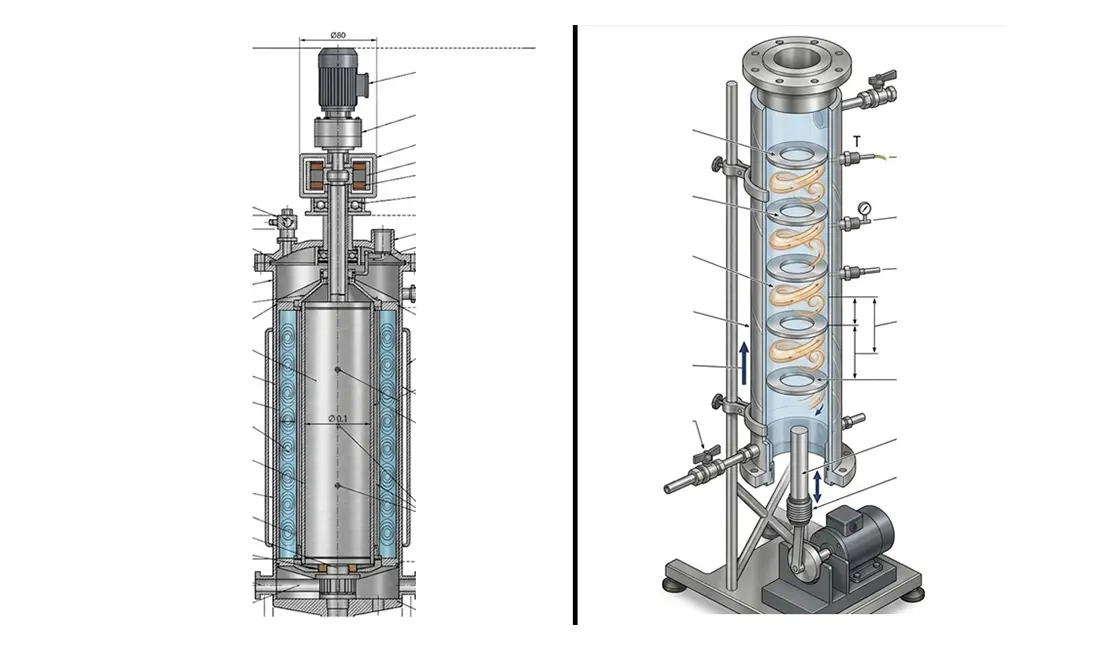
Taylor–Couette Reactor
Suited to homogeneous / liquid–liquid, low-to-medium viscosity, strongly exothermic systems with high shear-uniformity requirements (e.g., high-end polymerization, precision crystallization). Taylor vortices deliver uniform mixing and excellent heat transfer.
Oscillatory Baffled Reactor
Suited to processes sensitive to axial back-mixing, requiring precise residence-time-distribution control while suspending solids (e.g., continuous crystallization, enzyme catalysis, gas–liquid reactions). Periodic oscillation and baffles achieve near-plug-flow with enhanced mass transfer.
Series arrangement: This series focuses on the dynamic stirred tubular reactor; the Taylor–Couette reactor is treated in a standalone article; the oscillatory baffled reactor is introduced under the continuous-flow crystallization theme.
🧪 2. What is the theoretical basis of the DTR?
The core is radial complete-mixing + axial plug flow, approaching ideal plug-flow behavior.
Ideal Plug-Flow Reactor (PFR) model
All fluid elements move at an identical velocity (no axial dispersion), with complete radial mixing; concentration and temperature vary only along the axis. The residence time equals the nominal residence time (V = reactor volume, Q = volumetric flow rate).
Two deviations of real tubular reactors
- Radial velocity gradient: Under laminar flow this is a parabolic Poiseuille profile; velocity near the wall is far below that at the center → produces a residence-time distribution.
- Axial back-mixing: Molecular diffusion and turbulent mixing cause axial mixing of fluid elements at different reaction stages → blurs the concentration fronts.
Together these are called axial dispersion, quantified by the axial Peclet number (Peaxial):
u = axial mean velocity, L = reactor length, Dax = effective axial dispersion coefficient. Ideal plug flow: Pe → ∞; continuous stirred-tank reactor (CSTR): Pe → 0
DTR’s solution strategy
A rotating agitator produces strong radial mixing → rapidly eliminating radial concentration and temperature gradients. When the rotational speed exceeds the critical speed, the radial mixing time is far smaller than the reaction time:
R = tube radius, Deff,radial = mechanically enhanced effective radial dispersion coefficient.
→ Each cross-section can be treated as a well-mixed unit; only the axial direction retains a concentration gradient.
Preservation of axial plug-flow behavior
Axial displacement of the fluid is set by the total feed flow rate. With a sound agitator design, the rotating turbulence intensifies radial mixing but does not significantly increase axial dispersion.
Series-of-CSTRs model
The DTR can be conceptualized as N well-mixed stages in series; the larger N is, the closer the behavior approaches ideal plug flow, with the relation:
When , this is equivalent to 50 CSTRs in series, and near-ideal plug flow is achievable in practice.
In plain terms, a DTR is like stringing dozens of small reactors into a single tube — each one thoroughly mixed, yet the material as a whole is pushed forward step by step.
📐 3. How does the Axial Dispersion Model (ADM) quantify the DTR?
The ADM is the most commonly used quantitative framework for characterizing non-ideal flow in tubular reactors.
Governing equation (species A)
CA = concentration of species A, z = axial coordinate, u = axial mean velocity, Dax = axial dispersion coefficient, rA = reaction rate.
Steady-state simplification
With the time derivative set to zero, the equation becomes a second-order ordinary differential equation:
Boundary conditions
En Danckwerts boundary conditions describe the inlet and outlet diffusive fluxes:
- Inlet (z = 0):
- Outlet (z = L):
First-order irreversible reaction — analytical solution (rA = −kCA)
where , and Pe = uL/Dax.
Core conclusion: For a given Damköhler number (Da = kτ), a higher Peclet number (smaller axial dispersion) yields a higher conversion.
⚖️ 4. How do CSTR and PFR volume requirements compare?
For the same feed and conversion, the PFR requires far less volume than the CSTR, though industrial design must weigh multiple factors.
Design equations (isothermal, steady-state, ideal flow; rate decreases monotonically with conversion)
- CSTR:
- PFR:
Reason for the volume difference
The PFR maintains high upstream reaction rates throughout its length; the CSTR operates its entire volume at the lowest (exit) rate → VCSTR > VPFR.
First-order irreversible reaction — quantitative comparison (constant density, −rA = kCA = kCA0(1−X))
At conversion X = 0.9, .
→ At high conversion the CSTR volume demand is about 4× that of the PFR.
Industrial-design supplement: In practice one must also weigh heat transfer, safety, pressure drop, back-mixing, mass-transfer limitations, and operational stability.
🏗️ 5. What are the five core subsystems of the DTR?
There are five core subsystems that must work in concert to deliver performance.
| Subsystem | Core function | Key points |
|---|---|---|
| External pressure vessel | Primary pressure boundary + heat-transfer surface | Materials: 316L / 904L stainless steel, Hastelloy C-276, tantalum; inner diameter set by throughput + agitator design |
| Rotating agitation assembly | Core component enabling radial mixing | Mixing elements: paddle (low visc.), twisted ribbon (medium visc.), anchor (high visc.), specialty structures (dead-zone elimination); tip clearance is the key design parameter |
| Heat-transfer system | Precise temperature control | Methods: jacket, hollow agitator shaft with circulating medium, internal coils/tubes; independently zoned control |
| Dynamic seal system | Maintain pressure integrity | Types: mechanical face seal (single/double cartridge), magnetic drive, packing seal; highest maintenance frequency |
| Drive & control system | Provide controllable speed | Speed range 10–500 RPM; VFD continuous adjustment; integrated speed, torque, and vibration monitoring |
📝 6. Supplementary details & engineering trade-offs
- Naming clarification: The domestically common term “dynamic tubular reactor” refers narrowly to the dynamic stirred tubular reactor (DTR), and broadly also includes the Taylor–Couette and oscillatory baffled types.
- Physical meaning of the Peclet number: It is the ratio of convective to diffusive rate. The larger its value, the more the axial dispersion becomes negligible relative to the bulk flow, and the closer the reactor approaches plug flow.
- Dual effect of tip clearance: Too small a clearance risks wall scoring and poor mechanical stability; too large reduces mixing efficiency and promotes wall coking — a core design trade-off.
¿Quiere saber más sobre nuestros productos?
Ver todos los productos English
  Spanish
  Russian