Skid-Mounted Modular Design: From 1950s Oilfields to Digital Twins
Saltar a la sección
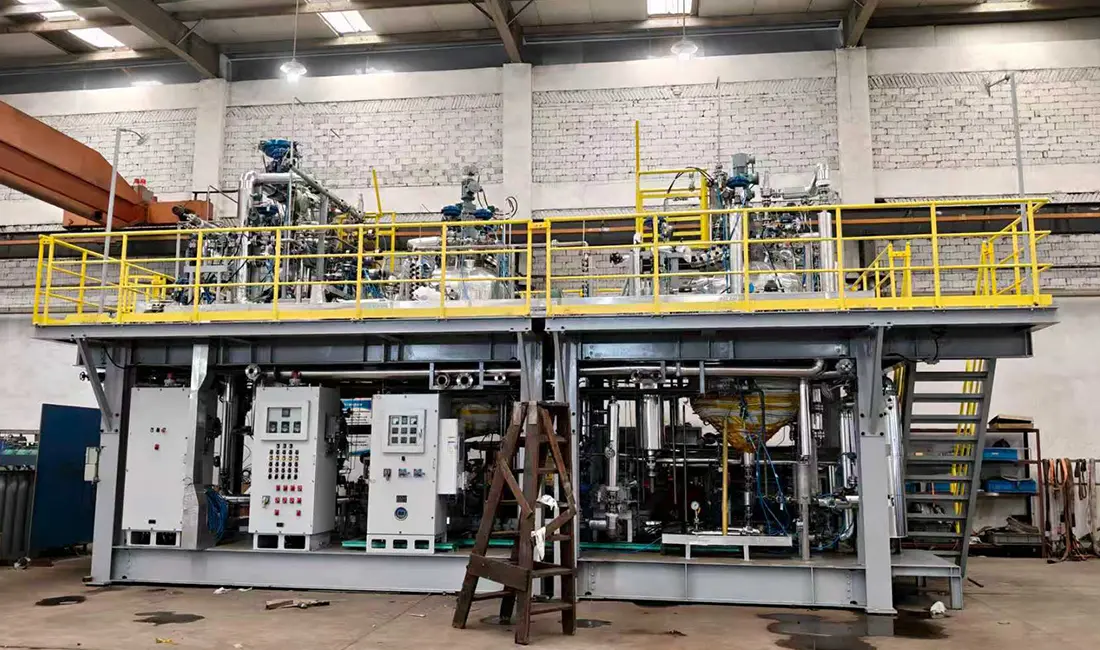
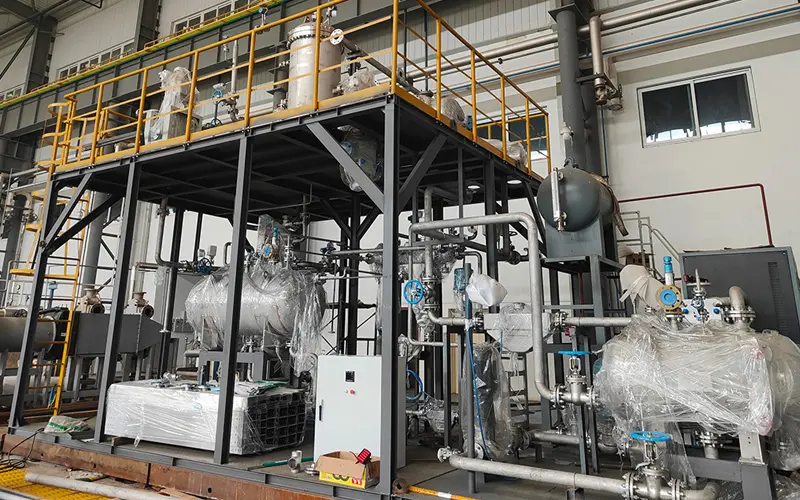
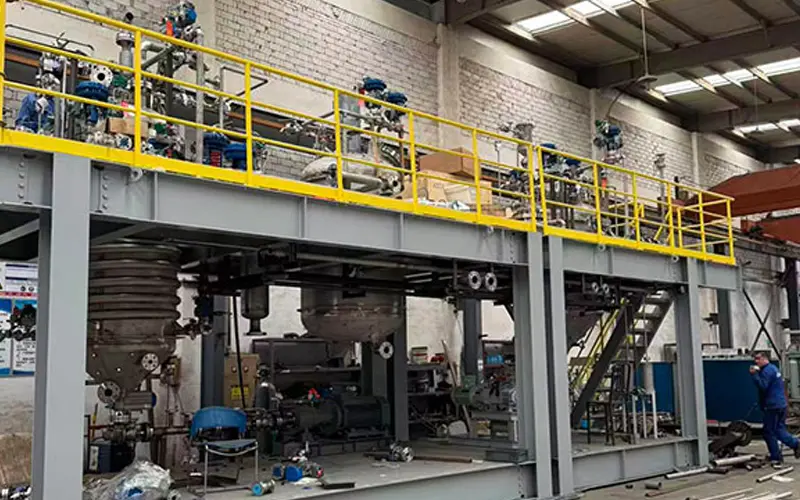
Skid-mounted modular design (SMD) integrates an entire process flow — equipment, piping, valves, instruments, electrical and control systems — onto one or more steel structural bases, so that manufacturing, assembly and testing finish in the factory before anything ships to site. The approach is mature, widely applied, and by industry accounts compresses project schedules by 30%–50% while improving quality and lowering cost.
But the method did not appear fully formed. It started in the oil and gas industry and has passed through four distinct stages, and it is now moving toward intelligent, green and standardized development. This article covers what SMD is, how it evolved, why it wins, what the design process actually involves, and where it is heading.
Looking for the design-level breakdown — skid dimensions, structural form, skid boundaries? That is a separate question, covered in Plant Modular Design: The Three Stages. This article looks at the method’s history, evidence and trajectory.
What is skid-mounted modular design? {#definition}
SMD is an engineering method that moves the entire process flow onto steel structural bases (“skids”), completes manufacturing, assembly and testing in the factory, then transports the finished modules to site for rapid installation and connection.
The scope of integration is the point. A skid is not just a frame under a pump — a full SMD module carries:
- En process flow itself
- Equipamiento, piping, and valves
- Instruments, electrical systems, and control systems
Everything travels as one tested, assembled unit. Site work shrinks to foundations, setting, and inter-skid connections — which is precisely where the schedule and quality advantages come from.
The four development stages {#stages}
SMD started in the European and American oil and gas industry in the 1950s–1960s and has passed through four stages, now entering the large-scale and intelligent era.
| Stage | Period | What happened |
| Emergence | 1950s–1960s | Originated in the oil and gas industry, created to solve the difficulty of building remote oilfields |
| Development | 1970s–1980s | Application expanded into chemical, power and other sectors, with standardization gradually improving |
| Integration | 1990s | The rise of 3D design software drove multi-discipline collaborative design and higher integration |
| Large-scale & intelligent | Present | Project scale has expanded; digital and intelligent technologies incorporated; functionality continues to grow |
The sequence rewards a second look, because each stage solved the previous one’s bottleneck:
- Emergence solved geography. Remote oilfields could not be built the conventional way — labor, logistics and inspection all fail at distance. Factory-built modules sidestepped the problem.
- Development solved replication. Once the oil and gas sector proved the method, chemical and power projects adopted it, and the industry built the standards that let one project’s lessons become the next project’s default.
- Integration solved coordination. Before 3D design software, multi-discipline clashes were found on site. 3D modeling moved clash detection into the design office — multi-discipline collaborative design became practical, and integration depth jumped.
- Large-scale & intelligent is solving scale itself. Bigger projects, digital tools, and expanding functionality.
Current level: mature and mainstream {#current}
The technology level is mature and market application is broad — SMD is the mainstream choice for large projects and overseas EPC projects, and it is moving toward intelligent, green and standardized development.
On the technology side:
- Highly integrated design software has greatly improved design efficiency
- Mature prefabrication and testing processes ensure ex-works quality
- The industry standard system keeps improving, with a high degree of standardization
On the market side:
- Application covers energy, chemical, environmental protection and new energy sectors
- It is the mainstream choice for large projects and overseas EPC projects
That last point matters for procurement teams: because SMD is standard practice in EPC delivery, vendor quotes, interface definitions and inspection regimes for modular work are established practice, not experiments.
Why it wins: the 30%–50% schedule advantage {#advantages}
The core advantage is a 30%–50% reduction in project schedule, alongside significantly improved quality and lower cost. Industry sources put the headline number between 30% and 50%; actual results vary by project type and site conditions, but the mechanism is unambiguous.
Schedule: parallel paths replace a single thread. Factory prefabrication and site preparation can run in parallel, breaking the traditional “single-thread” construction mode — what the industry calls “walking on two legs.” While civil work proceeds at the site, modules are being fabricated, assembled and tested in the shop. The two paths converge only at installation, so the overall project cycle compresses substantially.
Quality: a controlled environment beats a construction site. Precision manufacturing and rigorous testing are carried out in a standardized factory environment. Environmental interference drops, product quality becomes stable and reliable, and the on-site rework rate falls sharply. A weld made in a shop with positioners and fixed procedures does not need to be re-made in the rain.
Cost follows from both. Less site labor, less rework, and a shorter schedule each pull the project cost curve down — which is why modular delivery has become the default for overseas EPC work rather than a premium option.
The design process: 8 disciplines, 3 review gates {#process}
A full SMD design process spans 8 disciplines and runs through model reviews at 30%, 60% and 90% completion. The discipline count surprises people who think of a skid as “just piping” — the method is a plant in miniature, and the design process reflects it.
The 8 disciplines involved:
Process · Equipment · Piping · Electrical · Instrumentation/Control · Water & Firefighting · Building/Structure · Plot Plan
Each discipline has its own inter-discipline condition exchange and construction drawing list. The full design process covers: team formation, interface definition, inter-discipline condition exchange, 3D modeling, review, delivery, and change management.
Model review milestones. Reviews are conducted at three stages, each with a corresponding checklist:
- 30% review — layout and sizing directions are locked before detail work begins
- 60% review — inter-discipline clashes and interface issues are caught mid-stream
- 90% review — the model is checked against construction readiness before drawings release
The review structure is the design-office equivalent of shop testing: problems caught at 30% cost hours, the same problems caught at 90% cost weeks.
The tooling is specialized. Mainstream 3D piping software packages used across the industry include:
AVEVA PDMS / E3D · Hexagon Smart3D (SmartPlant 3D) · Autodesk AutoCAD Plant 3D · Bentley OpenPlant · Hexagon CADWorx · Zhongke Fulong PDSOFT · Zhongwei Shutong ZWPD · Digital China CAXA 3D Plant Design
Future trends: intelligent, green, standardized {#trends}
SMD’s development direction is summed up in three words: intelligent, green, standardized.
- Intelligent — introducing digital-twin technology. A module designed in 3D and reviewed at 30/60/90% is already a data-rich object; connecting that model to a live plant digital twin extends the design investment into operations.
- Green — promoting low-carbon process flows. Compact plants mean less material, less transport and less site energy; the factory environment also makes emissions and waste easier to control than on a construction site.
- Standardized — achieving plug-and-play modular interfaces. The closer interface design gets to true plug-and-play, the faster site installation becomes and the more reusable each module family is across projects.
The direction of travel is consistent with the method’s whole history: each stage moved work to where it could be done better — the shop — and the next stage is moving the information to where it can be used better — the full plant lifecycle.
FAQ {#faq}
What does “skid-mounted modular design” actually cover?
It integrates the entire process flow — equipment, piping, valves, instruments, electrical and control systems — onto one or more steel structural bases. Manufacturing, assembly and testing are completed in the factory, and the finished modules are transported to site for rapid installation and connection. The scope is a functioning process unit, not just equipment on a frame.
Where did skid-mounted modular design come from?
It originated in the European and American oil and gas industry in the 1950s–1960s, created to solve the difficulty of building remote oilfields. Application expanded into chemical, power and other sectors in the 1970s–1980s; the rise of 3D design software in the 1990s drove multi-discipline collaborative design; and the method has now entered a large-scale and intelligent stage.
How much schedule reduction does modular design deliver?
Industry sources put it at 30%–50%. The mechanism is parallel execution: factory prefabrication and site preparation run simultaneously instead of the traditional single-thread construction sequence, so the two paths converge only at installation. Actual results vary by project type and site conditions.
Which disciplines are involved in a full skid design?
Eight: process, equipment, piping, electrical, instrumentation/control, water and firefighting, building/structure, and plot plan. Each carries its own inter-discipline condition exchange and construction drawing list. The full process runs from team formation and interface definition through 3D modeling, staged reviews, delivery and change management.
What are the model review milestones, and why do they matter?
Reviews are held at 30%, 60% and 90% completion, each with a corresponding checklist. Early reviews lock layout and sizing before detail work; mid-stream reviews catch inter-discipline clashes and interface issues while they are still cheap to fix; the final review checks construction readiness before drawings release. Problems caught early cost hours; the same problems caught late cost weeks.
A note on the numbers: The 30%–50% schedule reduction, the stage dates (1950s–1960s onward), the 8-discipline list, the 8 software packages, and the 30/60/90% review structure all come from the source analysis this article is based on. The schedule figure is an industry-typical range, not a project guarantee — actual results depend on project type and site conditions.
¿Quiere saber más sobre nuestros productos?
Ver todos los productos English
 Spanish
 Russian