Development of Energy-Efficient Batch Process Technology for Green Polyether Polyol Production
Project Name: Development of Energy-Efficient Batch Process Technology for Green Polyether Polyol Production
Location: China,Zhejiang
Completion Date: April 30, 2026
Project Purpose:
The purpose of this pilot plant is to research and develop an energy-efficient batch process technology for green polyether polyol production, preparing for large-scale industrialization.Main Equipment:
Polymerization reactor, neutralization tank, prepolymer buffer tank, circulating heat exchanger, electromagnetic heater, reaction circulation pump, dehydration transport pump, exhaust gas condenser, dehydration tank, product cooler, hydrochloric acid cooler, dehydration tank, vacuum pump, distribution cabinet, electrical equipment, instrumentation cabinet, instrument valve, flow meter, control console, etc.
Process Description:
The preparation of polyols is divided into two stages: pre-polymerization reaction and polymerization reaction.
1.Pre-polymerization Reaction:
The initiator and potassium hydroxide liquid are added to the polymerization reactor from the feeding tank, and the circulation pump is started. Epichlorohydrin or ethylene oxide is gradually added to the polymerization reactor through a mixer, while the electric heater of the reactor is adjusted to maintain the reactor temperature at 125°C. During the reaction, the cooling water flow of the reactor cooler is adjusted, and the normal operating temperature depends on the grade of the polyol.
2.Polymerization Reaction:
A certain amount of prepolymer is added to the polymerization reactor from the prepolymer tank under nitrogen pressure, and the circulation pump is started. Epichlorohydrin or ethylene oxide is gradually added to the polymerization reactor, while the electric heater of the reactor is adjusted to maintain the reactor temperature at 125°C. During the reaction, the cooling water flow of the reactor cooler is adjusted, and the normal operating temperature depends on the grade of the polyol. After the feed of epoxide is completed, the product temperature in the reactor needs to be maintained until the reaction of epoxide is completed, obtaining the intermediate polyol with the target molecular weight.
After the production of a batch of polyol is completed, the polyol is transferred to the neutralization tank by the reactor circulation pump.
3.Neutralization Process:
In the neutralization tank, phosphoric acid and deionized water are added to the polyether polyol product containing potassium alcoholate, and stirring is performed for neutralization, where the potassium alcoholate is neutralized to potassium dihydrogen phosphate.
After the pH of the material in the tank reaches the standard, the next step begins. For different types of polyether, two desalting processes, vacuum dehydration and coalescence dehydration, are set.
Vacuum dehydration is carried out in the neutralization tank. After the coarse polyether polyol is dehydrated to meet the standard, it is cooled, pressurized, and then discharged into the ton barrel through the discharge valve.
Coalescence dehydration is carried out in the subsequent dehydration tank. In the dehydration tank, the material is quickly separated into two phases by the coalescence filter element, and then cooled and filled into the ton barrel separately.
4.Vacuum System:
The pilot platform includes a vacuum system consisting of a vacuum pump, cooler, and related valves, pipes, and instruments. The gas-phase pipes of the reactor and neutralization tank are connected to the vacuum system and evacuated by the vacuum pump.
Skid Composition:
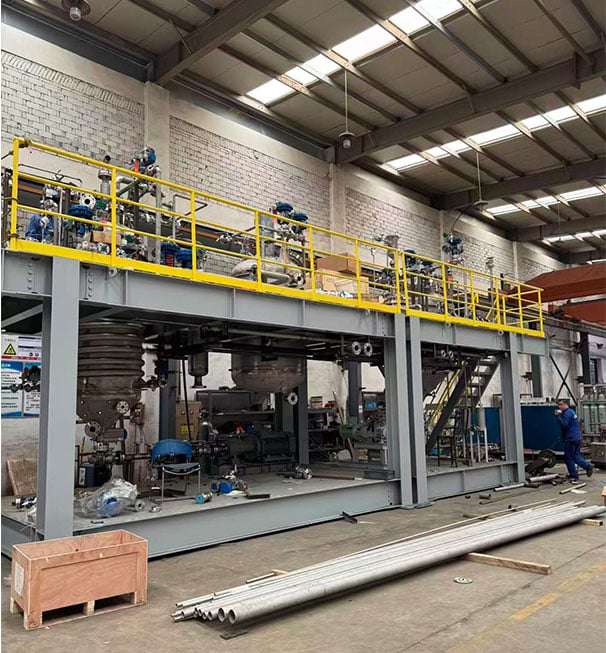
Considering factors such as transportation, lifting, and site use, the skid is mainly composed of two parts, with the steel structures of the two parts connected by bolts, and each part has two stories.
Framework 1: 3.25 meters (length) × 2.75 meters (width), with a removable overhang of 0.5 to 0.75 meters wide added to the second-story platform based on operational needs. The story height is 3 meters.
Framework 2: 5.2 meters (length) × 2.75 meters (width), with a removable overhang of 0.55 to 0.75 meters wide added to the second-story platform based on operational needs. The story height is 3 meters.
A 1-meter-wide removable staircase and a vertical ladder are provided.
 English
  Spanish
  Russian