Application Technology Development for a Three-in-One Filtering, Washing, and Drying Equipment for Semiconductor Materials in the Electronics Industry
I. Project Name:
Application Technology Development for a Three-in-One Filtering, Washing, and Drying Equipment for Semiconductor Materials in the Electronics Industry
II. Location:
Fujian, China
III. Completion Date:
February 15, 2026
Project Purpose:
To study the feasibility of using a three-in-one equipment for filtering submicron materials in the semiconductor industry through a pilot plant.
Technical Challenges:
- The material particle size is fine, approximately 1~2μm, making it difficult to achieve the required filter plate pore size.
- Slow filtering speed; long processing time; high pressure drop.
- Stringent requirements for iron ion content, increasing the difficulty of equipment manufacturing.
Main Equipment:
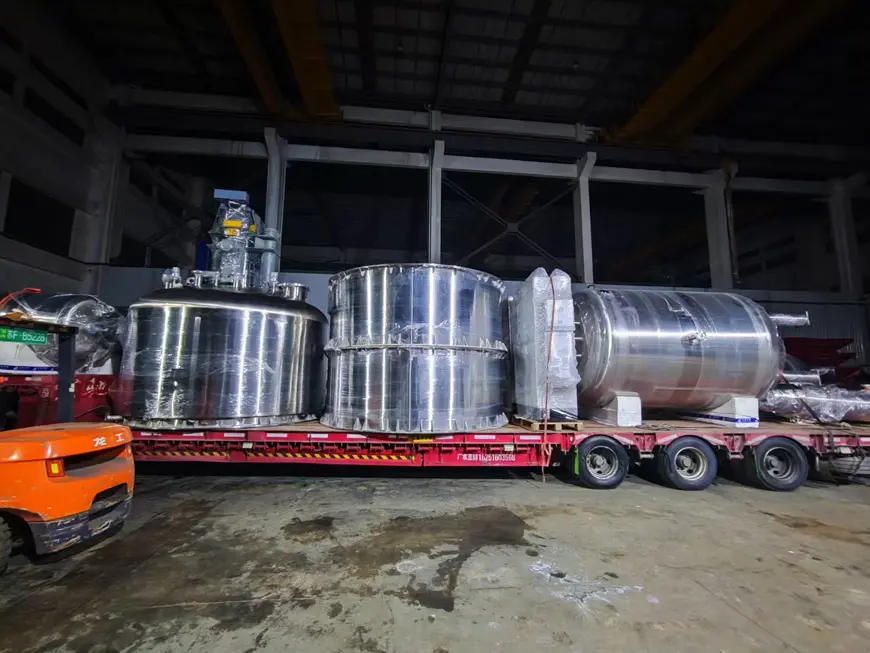
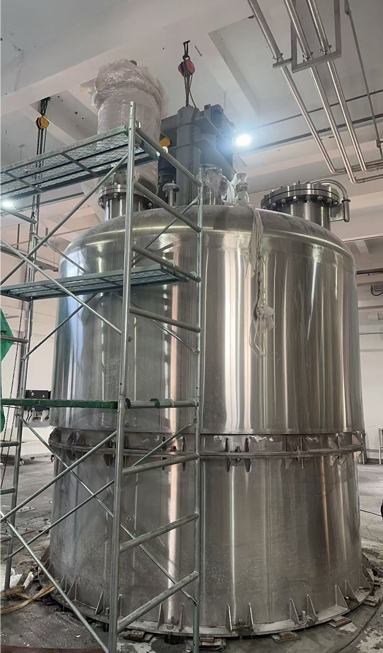
Three-in-one equipment (6㎡), raw material tank, raw material pump, mother liquid pump, mother liquid tank, condenser, condensate tank, heat source tank, vacuum pump, electrical control system, etc. The system can operate fully automatically without human intervention.
Process Description:
First, the raw material solution is transported to the feed tank. The raw liquid stored in the raw material tank is then pumped to the three-in-one equipment for sequential steps of pressurized filtering, slurry washing, pressure filtration, vacuum drying, and discharge. Due to the fine particle size of the filtering material, which has reached the limit of the sintered plate pore size, there is a slight leakage phenomenon (about 0.3%). The filtrate is further filtered through a small plate filter to recover the leaked material, improving the material recovery rate. The feed section can achieve precise control of the feed volume through flow meters, control valves, and variable frequency feed pumps, ensuring that the feed volume is within the upper limit of the equipment, with an error range of ≤1%. The pressurized filtering pressure is controlled between 0.3~0.8MPa to balance filtering efficiency and leakage rate. The drying process controls the appropriate vacuum level and heating temperature to meet the drying time requirements. Iron ion content control: Appropriate material selection and surface treatment processes are adopted to ensure that the iron ion content in the material meets customer requirements. Multiple temperature sensors, pressure sensors, flow sensors, and level sensors are installed at various locations in the system to accurately monitor the operating temperature, pressure, level, and feed volume. The entire system can operate fully automatically without human intervention.
Application Scenarios:
The three-in-one filtering, washing, and drying equipment (referred to as “three-in-one”) is characterized by its fully enclosed, single-tank design for solid-liquid separation, multi-stage washing, vacuum drying, and discharge. It is primarily used for high-purity, sterile, heat-sensitive, and toxic or explosive materials and is widely used in industries such as pharmaceuticals, fine chemicals, new energy electronic materials, food, and biological products. This case focuses on its application in the electronics semiconductor industry.
Ekaislot Advantages:
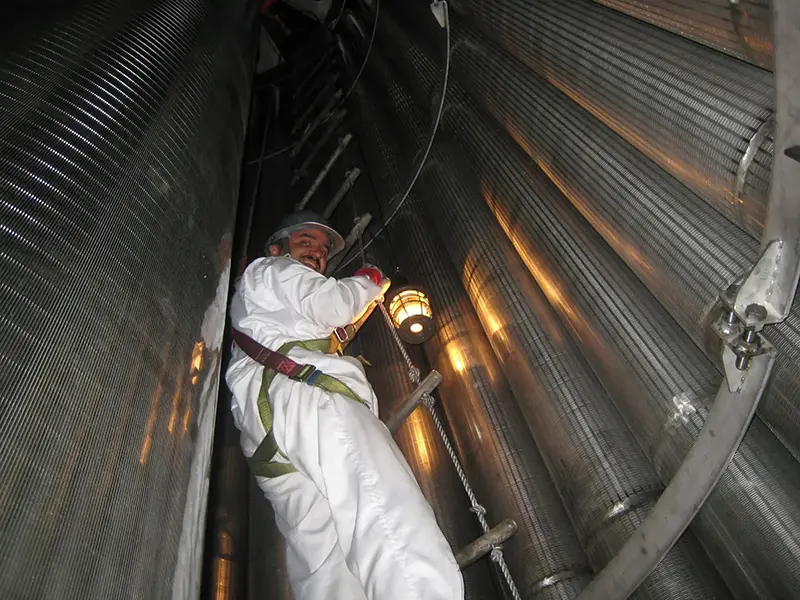
The three-in-one project involves design, manufacturing, installation, equipment, instrumentation, electrical, safety, and environmental protection, among other professional fields. Due to its wide scope, it poses certain difficulties and complexities. Shanghai Ekaislot possesses the qualifications for pressure vessel manufacturing, has 14 years of experience in equipment design and manufacturing, and has a team of experienced process technicians. The company has developed test units for scraped surface evaporators, three-in-one equipment, silicon carbide membrane systems, candle filter systems, vacuum systems, and microchannel reactors. The technology development of the three-in-one filtering, washing, and drying equipment is rapidly advancing towards intelligence, automation, and efficiency. The integration of multiple cutting-edge technologies will fundamentally change the operation mode and performance boundaries of the equipment. Innovations in new materials and processes will bring about significant improvements in equipment performance. The application of advanced technologies such as nanofiltration materials, supercritical drying, and microwave-assisted heating will further enhance the separation precision, drying efficiency, and energy utilization of the equipment. Particularly in the production of high-value-added products such as new energy materials, the application of these new technologies will bring significant economic benefits and competitive advantages.
 English
  Spanish
  Russian