Microchannel Reactors Advantages, Challenges &Standardization — A Full Analysis
Jump to section
1. Core Advantages of Microchannel Reactors
A common misconception must be clarified first: the “micro” in microchannel reactors does not mean the overall device is small — it refers to the characteristic dimension of the reaction channels being at the millimeter scale (the draft standard defines it as no greater than 5 mm). It is precisely this “micro” that creates a series of fundamental advantages, which can be grouped into four dimensions.
① Inherent safety: from “reducing harm” to “eliminating at source”
- Low hold-up: The effective internal volume is very small; even if a runaway occurs, the total energy released is far less than in a conventional reactor, lowering accident severity at the source.
- Extremely high surface-to-volume ratio: Tens to hundreds of times that of a batch vessel, giving very strong heat-transfer capacity that promptly removes reaction heat and avoids “temperature runaway.”
② Controllable process: precise to seconds or even milliseconds
- Instantaneous uniform mixing: Within channels, laminar or micro-scale mixing rapidly reaches molecular-level uniformity — fast rates, fewer side reactions, narrow residence-time distribution.
- Second / millisecond residence control: For systems with unstable reactants or products, the reaction can be precisely controlled “only to the extent needed.”
- Easy harsh conditions: High-temperature and high-pressure reactions are easier and cheaper to achieve here than in batch equipment.
③ Process performance: scale-up no longer “from scratch”
- Small scale-up effect: Scale-up is done by “increasing channel count” rather than “enlarging single-channel size,” so lab conditions transfer directly to production scale — drastically shortening development cycles. This is the most disruptive advantage over batch.
- Flexible production: Under continuous operation, capacity is adjusted simply by changing runtime or adding/removing parallel modules — well suited to multi-product, small-batch modes.
- Better yield: With side reactions suppressed, yields are generally higher than in batch processes.
④ Green & eco-friendly: less waste, smaller footprint
- Less by-product and waste generation; high volumetric productivity; footprint significantly smaller than traditional units.
2. Five Major Challenges: Great in theory, with real barriers to deployment
The microchannel reactor is not a “master key.” Its industrial adoption still faces five challenges: cost, technology, adaptability, standards, and safety.
1 High industrialization cost
High-precision manufacturing (diffusion bonding, precision machining, etc.) makes the initial purchase cost higher than conventional equipment; single-unit capacity is small, so large-scale production requires many parallel/series units, raising both investment and control complexity. Later, a professional maintenance team and dedicated tooling are needed, so long-term operating costs are not negligible.
2 Gaps in technical reliability
- Picky about material form: Solids, high-viscosity fluids, and coking-prone systems readily clog the channels.
- Sensitive to manufacturing defects: Under harsh conditions, seal failure may cause leakage.
- Reduced multiphase efficiency: In complex multiphase systems, heat- and mass-transfer efficiency depend on flow-pattern control and feed distribution; performance may degrade after long operation.
Supplement: Among continuous-flow technologies, the rotary/scroll tubular reactor is a good alternative or complement to microchannels for systems containing minor solids or requiring intense mixing.
3 Limited process adaptability
Switching from a traditional process requires heavy R&D investment; processes with complex reaction pathways, very long reaction times, or extreme sensitivity to condition fluctuations are difficult to adapt.
4 Missing industry standards
Domestically there were very few relevant standards before, leaving design, selection, and safety assessment without unified norms — the direct background for this national standard.
5 Inherent safety is relative
- When channels clog or temperature/pressure monitoring fails, local accumulation and runaway can still occur.
- Catalyst loading for heterogeneous reactions is difficult: fixed beds have high pressure drop, while flow-loaded catalysts easily clog tubes.
- Beware the “fake continuous” trap: The reaction section is continuous, but downstream processing remains batch — online inventory is not reduced, failing the inherent-safety goal of fewer people and less inventory.
3. How Should Enterprises Select? Not blindly, not one-size-fits-all
Prioritize applicable scenarios
Strongly exothermic, high-hazard reactions (e.g., nitration) and mild continuous-flow reactions are the top-priority applications. The “Ten Articles on Nitration” explicitly require assessing whether a tubular/microchannel retrofit truly improves inherent safety — retrofitting is not the goal; the safety gain is.
No one-size-fits-all replacement
A more pragmatic path is the hybrid process: keep the batch reactor as the main body and introduce the microchannel as a supplementary module for critical steps such as fast mixing and strong exotherm, achieving complementary strengths.
Reference on policy direction
Some provinces encourage hazardous processes (nitration, chlorination, etc.) to adopt continuous-flow equipment first — but only where the technology is mature and reliable. Enterprises should make an objective assessment based on their own reaction characteristics, production scale, and economics, rather than rushing in for “policy dividends.”
4. Progress & Key Points of the “Microchannel Reactor” National Standard
Development progress
- Late October 2025: The standard kickoff meeting was held at Shandong Himile Machinery Co., Ltd., hosted by the Heat Exchanger Subcommittee of the National Technical Committee for Boiler & Pressure Vessel Standardization.
- November 2025: The draft for comment was completed.
- Companion standard: “Microchannel Heat Exchanger” (GB/T 47194-2026) is about to be implemented, providing an important reference for the reactor standard.
- Drafting units: Led by Shandong Himile Machinery Co., Ltd., together with Gansu Lanpec, Xi’an Jiaotong University, Sinopec Engineering (SEI) and 20+ other organizations.
- Standard positioning: Regulate the industry, serve the national high-end equipment and safety strategy, and drive the green intelligent transformation of the chemical industry.
Scope of application
| Item | Provision |
|---|---|
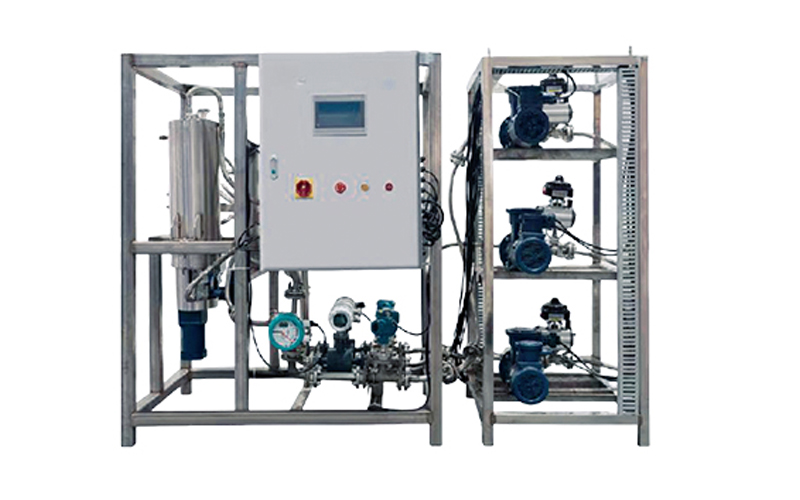
| Applicable object | Microchannel reactors and skid auxiliary equipment (pumps, instruments, valves, piping, electrical control, etc.) |
| Design pressure | Metallic ≤ 35 MPa; silicon carbide ≤ 5 MPa |
| Design temperature | Steel per GB/T 150.2; silicon carbide −60 ℃ ~ 250 ℃ |
| Not applicable | Structurally catalyzed reactors with surface-coated catalyst, glass / polymer-plastic made, tubular/pipeline, or 3D-printed reactors |
Key definitions
- Microchannel: A flow channel with a characteristic dimension no greater than 5 mm, divided into reaction channels and heat-transfer channels.
- Hold-up: The volume of reacting medium contained between the inlet and the outlet.
- Residence time: The time required for the medium to flow from the inlet to the outlet.
Classification & model designation
By structure, divided into detachable (suited to fouling/clogging-risk duty) and non-detachable (suited to duty with pressure > 10 MPa).
Model composition: RM (reactor + microchannel) + structure code + material code + nominal hold-up (×10−6 m3).
| Category | Code | Meaning |
|---|---|---|
| Structure | S | Detachable |
| W | Non-detachable | |
| Material | S | Stainless steel |
| T | Titanium | |
| N | Nickel & nickel alloys | |
| Z | Zirconium & zirconium alloys | |
| C | Silicon carbide |
Example: RMSS120 = detachable stainless-steel reactor with a hold-up of 120×10−6 m3 (i.e., 120 mL).
Material-selection tip: Silicon carbide is corrosion-resistant but low-pressure (≤ 5 MPa), suited to strongly corrosive, low-pressure duty; stainless steel / titanium / nickel / zirconium systems are high-pressure (≤35 MPa), suited to high-pressure duty.
Core technical requirements (key points)
★ Key indicators at a glance
- Hold-up allowable deviation: ±10% (of design value).
- Heat-load design margin: Not less than 20%.
- Plate flatness: ≤ 0.02 mm within any 200 mm × 200 mm area.
- Diffusion-bonding deformation: ≤ 1 mm within any 200 mm × 200 mm area; thickness deviation < 5%.
- Control-system history retention: Not less than 90 days.
- Instrument-air receiver: Guarantee ≥ 30 min of supply upon power/air failure.
- Hold-up < 1 L: Emergency relief system may be omitted unless otherwise specified.
Inspection & testing requirements
- Non-destructive testing: Butt joints — 100% radiographic or ultrasonic testing + 100% magnetic-particle or penetrant testing.
- Pressure test: Reaction and heat-transfer channels tested separately; the heat-transfer channel is tested only after the reaction channel passes.
- Heat-transfer test: No fewer than 5 operating points; deviation between calculated and measured values ≤ ±10%.
- Pressure-drop test: No fewer than 4 operating points (25%, 50%, 75%, 100% of design flux); deviation = the larger of ±10% and 0.1 MPa.
- Leak rate: General medium < ; extremely / highly hazardous medium < 10⁻⁵ ~ 10⁻⁷ Pa·m³/s.
5. Conclusion
Microchannel reactors use “millimeter-scale channels” to reconstruct the mass- and heat-transfer logic of chemical reactions, offering advantages in inherent safety and process scale-up that batch processes can hardly match; yet they are not a universal solution — cost, clogging risk, process adaptability, and standards gaps are all real constraints. The development of the national standard (comment drafting launched in 2025) is filling the “standards gap,” providing a unified basis for design, manufacturing, selection, and regulation.
For enterprises, the rational path is: take safety gain as the yardstick, reaction characteristics as the premise, and the hybrid process as the transition — so that microchannel technology truly creates value in the right scenarios.
Want to Know More About Our Products?
View All Products Now English
  Spanish
  Russian